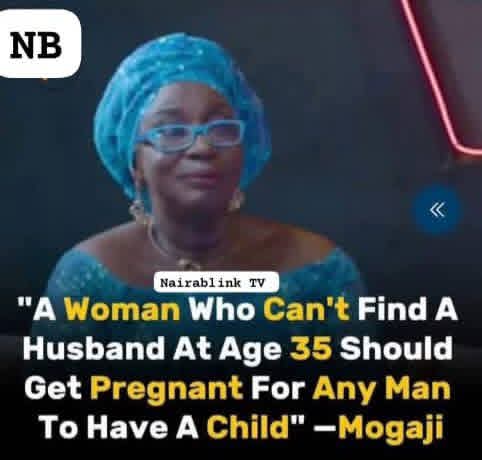
“A woman who can’t find a husband at age 35 should get pregnant for any man to have a child.” — Mogaji
This statement has sparked intense reactions across social media, and understandably so. It touches on deeply personal issues – womanhood, marriage, age, fertility, culture, and societal pressure—subjects that have long shaped conversations in African societies and beyond.
While some see the statement as “practical advice,” others view it as dismissive, harmful, and reductive to women’s lived experiences.
To understand why this statement is controversial, we must first examine the cultural lens from which it likely emerged.
In many traditional societies, particularly in parts of Africa, a woman’s value has historically been tied to marriage and motherhood. From a young age, girls are socialized to believe that their ultimate fulfillment comes from becoming wives and mothers.
Read More: Let Him Do the DNA Test” — Lawyer Advises Wives
As a result, age milestones—25, 30, 35—become silent deadlines imposed by society, not biology alone.
By age 35, a woman who is unmarried often faces intense scrutiny:
“Why are you still single?”
“Are you too picky?”
“Is it that you are cursed?”
“Who will carry your name?”
These questions are rarely asked of men the same age.
Supporters of the statement argue from a biological perspective, noting that female fertility declines with age and that waiting indefinitely for marriage may reduce the chances of having biological children.
From this viewpoint, the advice is framed as “realistic,” urging women to prioritize motherhood even if marriage has not happened.
However, this argument ignores several critical realities.
Read More: Popular Streamer Peller Has Announced his Decision To Withdraw From School.
Firstly,
Motherhood is not a casual decision.
Getting pregnant “for any man” is not a simple transaction—it comes with emotional, financial, psychological, and social consequences.
Raising a child requires stability, support, and intentional planning. Encouraging women to have children without considering the long-term impact on both mother and child reduces motherhood to a survival strategy rather than a meaningful life choice.
Secondly,
The statement places all responsibility on women, while absolving men entirely. It does not ask why many men avoid commitment, delay marriage, or abandon responsibility. It does not question societal structures that reward men for late marriage while punishing women for the same.
This imbalance reinforces a system where women are blamed for circumstances often beyond their control.
Thirdly,
The statement implies that a woman’s worth diminishes with age if she is unmarried. This is deeply problematic.
Women are not expired goods, and life does not end at 35. Many women find love later in life, build successful careers, adopt children, choose child-free lives, or pursue alternative paths to fulfillment.
It also ignores medical advancements. Today, women have more reproductive options than ever before—IVF, egg freezing, adoption, surrogacy, and informed family planning. Reducing the conversation to “get pregnant for any man” oversimplifies a complex biological and social issue.
Read More: History Made! 🔥🎬KOLEOSO Crosses 100 MILLION Views on YouTube
Moreover, the statement can unintentionally promote single motherhood without support, which in societies lacking strong social welfare systems can place women and children at significant disadvantage. While many single mothers thrive and raise exceptional children, no woman should be pressured into that path by fear or shame.
That said, it is also important to acknowledge that some women consciously choose motherhood without marriage, and that choice deserves respect.
Feminism and modern thought are not about rejecting motherhood but about choice without coercion.
The problem is not a woman choosing to have a child at 35; the problem is society telling her she must do so or risk being “incomplete.”
Ultimately, the conversation should shift from judgment to support.
Instead of asking women why they are unmarried at 35, society should ask:
Are we creating healthy relationship models?
What about men? Are men being taught accountability and emotional responsibility?
And are women being supported regardless of marital status?
Are we allowing people to live full lives on their own terms?
Marriage is a partnership, not a trophy
Motherhood is a calling, not a deadline. And a woman’s life is valuable at every age—married or not, with children or without.
Statements like this may come from concern, tradition, or fear of societal change, but they must be examined critically. Words matter. Public commentary shapes norms, and norms shape lives.
Read More: From Street Hustle to New Hope: The Story of 19-Year-Old Samuel” 😳 👍 😊
In a modern society, the goal should not be to rush women into decisions rooted in pressure, but to empower them with choice, dignity, and support.
Because no woman should feel that her life clock defines her worth.